

Written By: Dr Mehwish Niaz
Edited By: Dr Leanne Braganca
“If you have a writer’s block, take a walk, go to a party, wait for a couple of days, have a dream, don’t worry about writer’s block” Steve Martin
Writer’s block is a very common condition affecting 94% of writers in the world. The condition causes writers to feel blocked from starting and continuing writing. People experiencing writer’s block often recount feeling uncomfortable before even starting to write. The feeling may persist even as the writer continues to work on the draft. Creative writers experience ‘creative blocks’ and are unable to showcase their creativity effectively. All of this may have repercussions on the professional lives of the writers.
It’s important to remember that having writer’s block does not mean you lack the skills to write. It affects the best of writers and has nothing to do with your professional acumen. It is temporary and can be overcome by learning to deal with it effectively.
In this article I aim to help aspiring medical writers in identifying what the different causes of writer’s block may be. I will also outline practical strategies and exercises that writers can use to address their writer’s block and re-start their stalled projects.
The Challenge
Common causes of writer’s block
All of these are major factors that could influence a writer’s pace of work and lead to writer’s block. Knowing these could help writers pre-emptively address them and prevent it from happening.
A systematic review by Rehmat et al.(2026) on 21studies found that writer’s block is not a single entity but multidimensional and involves a number of factors: motivational, linguistics, behavioral, cognitive, and environmental.
All of these engage with contextual issues and rarely function in isolation. The reasons are invariably associated with poor academic writing skills, cognitive overload, anxiety, fear of assessment judgment, institutional demands, and lack of instructions.
Another study by Ahmed et al.(2022) in which 146 writers completed an online mixed- method survey found that there are four causes of writer’s block- physiological, motivational, behavioral and cognitive. Among these, motivational and physiological were the most prevalent.
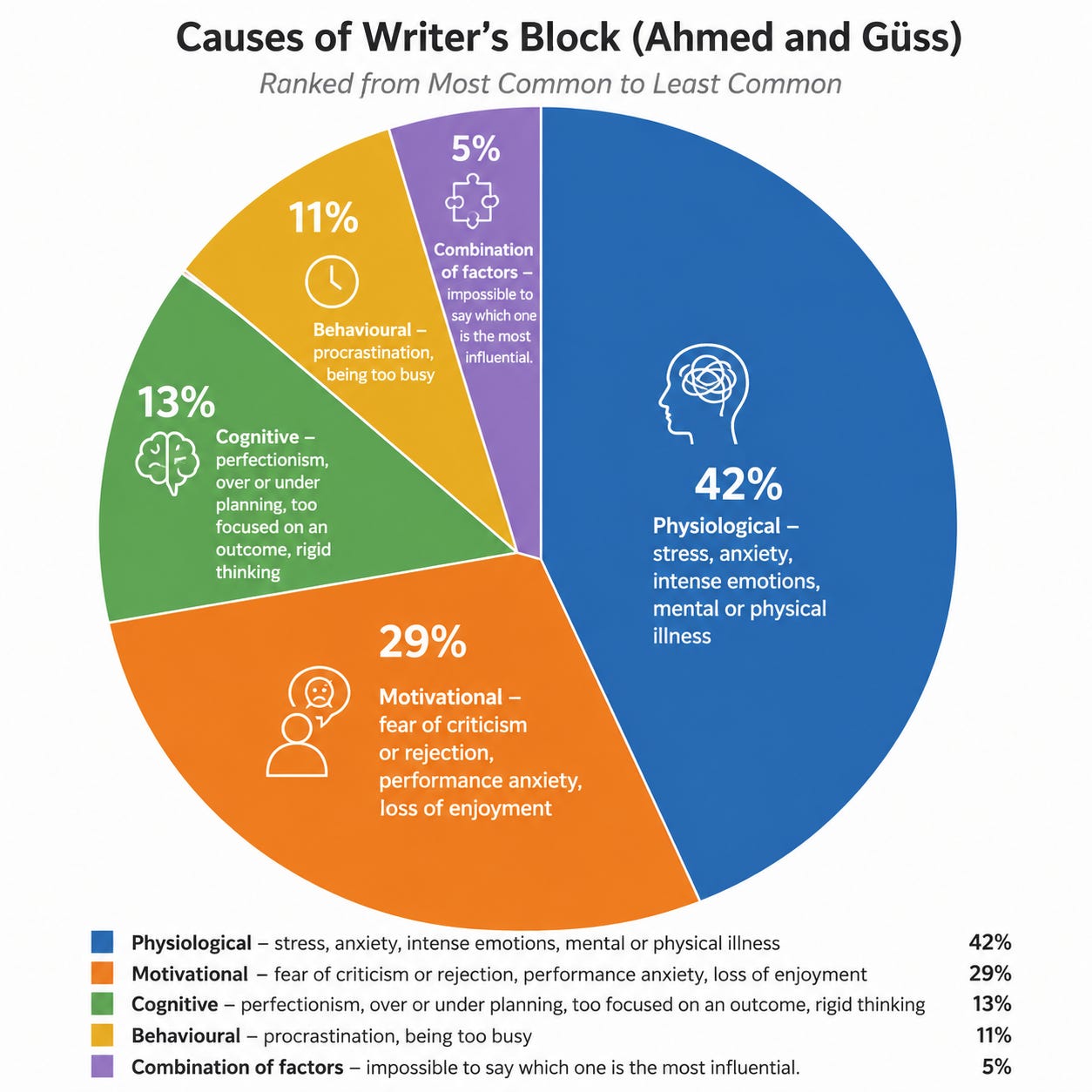
Writers may have to face this obstacle because of the following reasons:
Psychological factors, i.e., Anxiety, stress or physical exhaustion. It is the most common cause of writer’s block.
Lack of motivation or fear of being judged,
The pressure and strictness of meeting a deadline which could hamper the writer’s ability to think and write smoothly.
Imposter syndrome which could make the writer doubt their capability to write well.
Difficulty in articulating their point appropriately.
Not planning a rough draft outline before beginning to write.
Not focusing on what the key takeaway from the article should be to readers.
The quest for perfectionism and repeated edits to achieve the draft (Known as ‘Perfect Draft Syndrome’).
Feeling overwhelmed and procrastinating and delaying the writing further.
Environmental distractions which could detract the writer’s focus from their work.
Common Solutions
Useful Strategies
According to this study, some useful strategies that can be used to overcome writer’s block are:
Supporting early-career writers who are beginning their journey with helpful advice on how to deal with writer’s block
Cognitive and behavioral therapies of the writer before and during writing.
Using AI tools, i.e., Grammarly which can be helpful in making grammatic corrections in the drafts.
Practical Exercises
First, make write a draft. Edit later. It will save you from ‘Perfect Draft syndrome’.
The WIRMI technique- Begin your writing with the “What I really mean is” strategy. It will help you clarify your thoughts and help you explain your point of view in a simpler way.
Work with a schedule . It will help you avoid delays. Make a proper schedule so you will be motivated to stick to the plan.
Brainstorm and plan your article outline prior to writing
Break the task into micro-tasks. Write compulsively for a short duration of ten minutes and then take a break for the next ten minutes. Spending time thinking about what is distracting you during this break can help you confront and address the cause.
Last but not the least, appreciate the effort you have put in.
Practical tips by Famous writers to overcome writer’s block and increase productivity
Rigid daily schedule: Stephen King has developed a strict routine which starts daily around 8am. He has set a daily goal to write 2,000 words each day
20-minute writing (Pomodoro technique): Tomi Adeyemi Adeyemi writes for twenty minutes followed by a short break. It helps her keep her mind fresh and active.
Deep work period followed by physical exercise: Haruki Murakami is an early morning person who wakes up at 4:00AM, writes, and then follows it up with a physical exercise routine. This helps him maintain consistency.
Noise- cancellation techniques: Therese Walsh shuts off all external distractions, i.e., internet and social media applications. This helps her to maintain a flow of words while writing. She also uses noise-cancelling headphones that help her focus.
My Approach
Sometimes when I start writing a draft, I find myself looking at the white paper on my desk and feeling numb and unsure about how to proceed. It has, on occasion, even delayed my assignments. I wondered if this was a serious issue and started looking for ways to deal with it. I discovered that this is something common enough to affect every writer at some point or the other — writer’s block.
My experience in overcoming writer’s block involves certain strategies like:
Avoiding perfectionism and editing while writing. I always accept my initial messy draft, and edit it later.
Using AI to help me search for ideas. I then recreate those ideas in my own words and start writing in my own way.
Doing good research prior to writing. Research is the foundation of good writing and helps me decide if I need to change the topic if I find that another one feels more suitable.
Writing about trending topics, while making sure that I am comfortable writing about it.
Reminding myself that I do not need to write everything all at once. I can take time and complete the draft in parts as opposed to finishing it entirely in one sitting.
Finding a peer-community on platforms like Substack can also help writers feel more motivated.
My personal experience is that the more you write and gain skills, the more confident and comfortable you become with writing about different topics.
Other Voices on This Topic
Consider reading these additional articles for unique perspectives and advice.
Overcoming Writer’s Block with Confidence (writer’s block perspective 1)
Methods to adjust mindset and improve organization for unblocking writing
References
Noor Hanim Rahmat, Sharifah Amani Syed Abdul Rahman, Hawa Syamsina Md Supiee (2026). Writers’ Block in Academic Writing: A Systematic Literature Review of Types, Causes & Intervention. , 10(2).
Gardner, S. A., Salto, L. M., Riggs, M. L., Casiano, C. A., & De Leon, M. (2018). Supporting the Writing Productivity of Biomedical Graduate Students: An Integrated, Structured Writing Intervention. CBE life sciences education, 17(3), ar45.
Ahmed, S. J., & Güss, C. D. (2022). An Analysis of Writer’s Block: Causes and Solutions. Creativity Research Journal, 34(3), 339–354.
University of Illinois Urbana-Champaign. Strategies for Overcoming Writer’s Block. Writers Workshop.
AI Disclaimer
ChatGPT was used for correcting minor grammatical errors while writing this draft.
Contributions of Blog Creator
Nicole Bowens, PhD, developed the topic for this article. She created this blog to bring together perspectives from medical writers at all experience levels, with the goal of supporting those who are aspiring or early in their careers.
If you are interested in contributing to the blog as a writer or editor, fill out the Google form application, and you will receive a follow-up email with further instructions.
About the Contributing Author
This article was written by Dr.Mehwish Niaz, MBBS, specialized in internal medicine. Two years back, she has transitioned her career from clinical to medical writing. Linkedln is her main platform where she writes on different scientific topics. She has also launched Evidence Pulse, a newsletter where she has contributed a few articles on health and scientific topics. She has shared her experiences how she could be able to overcome her writer’s block as a beginner in medical writing.
Contributor Contact Info
Writer: Dr Mehwish Niaz
📧 Email: mishakhan412@gmail.com
🔗 LinkedIn: https://www.linkedin.com/in/dr-mehwish-167924160/
Editor: Dr Leanne Braganca
📧 Email: leanne.braganca@gmail.com
🔗 LinkedIn: https://www.linkedin.com/in/dr-leanne-braganca-85b194357/
WIRMI is the one I would put at the top of this list. I read manuscripts as a journal editor, and the drafts that stall usually stall because the writer has not decided what the argument is yet, so every paragraph hedges against a claim that was never actually made - "what I really mean is" forces that decision on page one instead of in round three of peer review. The addition I would make for medical writers specifically is to start with the Methods section, because it is the one part you can write without having to be right about anything yet. You did the thing, and you describe the thing. The introduction stops being frightening once there are already 800 words in the file.