
Learning to Write with Impact
How Adult Learning Principles Capture Values that Underpin Impactful Medical Writing

Written By: Xanthea Heighington, PhD
Edited By: Dr Reena Shetty
When seeking to produce truly impactful medical writing projects, understanding how people learn and absorb information is just as essential as the content itself. Studies of key learning theories show that adults learn most effectively through active engagement, self-reflection and relevance to real-world practice. These established adult learning principles can be used in a holistic approach to improve the skills of medical writers while maximizing the impact of their projects.
Research/Evidence
From hands-on experience to self-reflection and human connection, adult learning theories capture the values that drive adults to retain and apply information.1
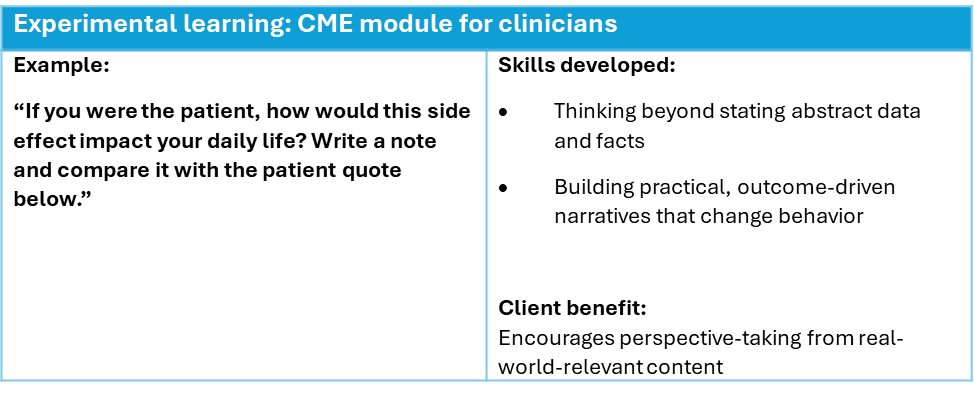
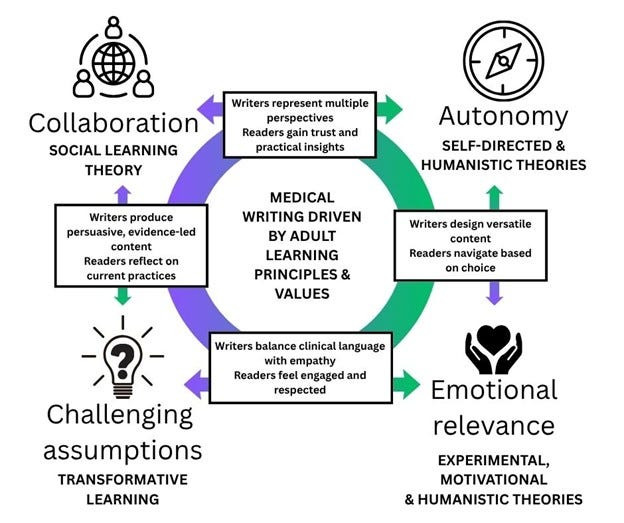
Experimental learning involves learning from experience, through simulating and imagining real scenarios so that learners apply knowledge in a realistic context. Evidence shows that learning by doing leads to the development of stronger, longer-lasting skills. A study involving more than 500 medical students found that those who learned through hands-on simulation performed far better and felt more confident than those taught through lectures alone.2 This highlights how experimental learning theory can make medical writers’ content more engaging and impactful by transforming abstract data into real-world contexts that can be applied in practice.
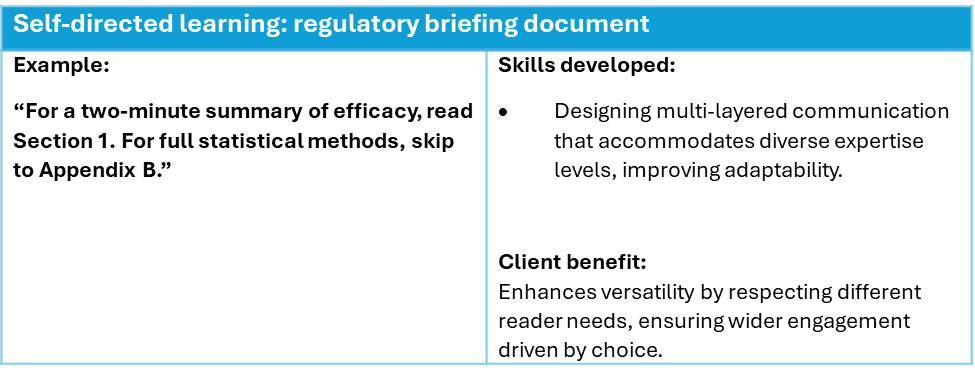
Self-directed learning empowers learners with the autonomy to choose the direction, pace and depth of their engagement with content. A recent set of studies, one which reviewed findings involving 2,098 undergraduate medical students and another analyzing data from 1,792, found that those who were given control over how and when to study achieved significantly higher test scores than those who followed a fixed programme.3 This supports the design of materials that empower audiences to navigate according to their needs. It also improves usability, relevance and engagement across readers with different levels of expertise.
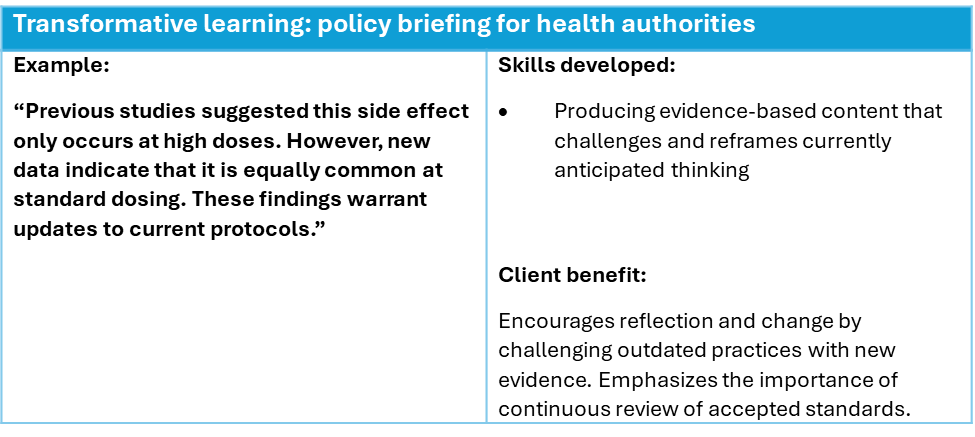
Transformative learning challenges existing assumptions or beliefs that learners may have, encouraging them to reflect and develop their perspectives. Challenging what professionals know genuinely introduces shifts in practice. A review of 77 graduate medical education studies found that 70% of trainees reported measurable behavior changes when their communication skills training considered real-world challenges and reflection.4 This supports the application of transformative learning theory to develop evidence-based content to reshape thinking, challenge outdated assumptions and foster impactful behavioral or policy changes.
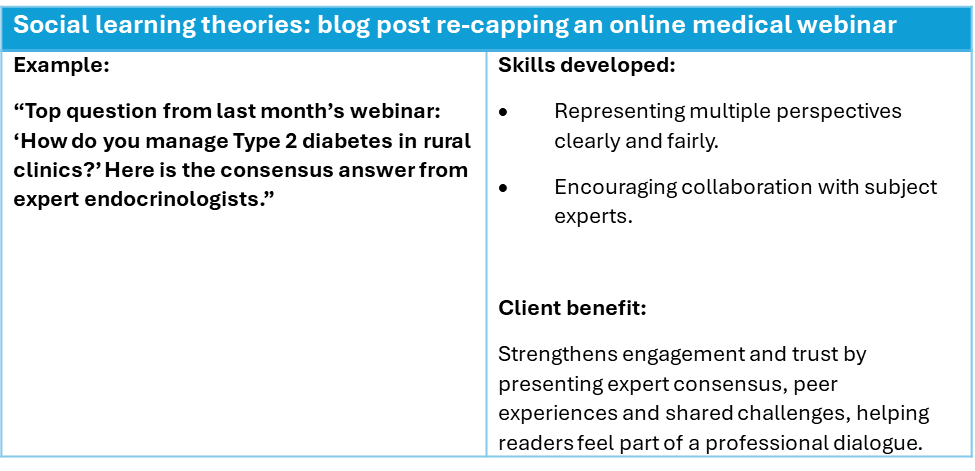
Social learning theories involve learning through the shared insights of their community and peers, through observation, modelling and interaction. Learning with and from others strengthens understanding and confidence in applying training. Compared with solo study, nursing training programs involve peer discussion, collaborative problem-solving and shared feedback significantly improve knowledge and practical skills.5 This supports the incorporation of multiple perspectives, including expert quotes and consensus statements, into medical writing projects to enhance trust and engagement through peer validation and shared expertise.
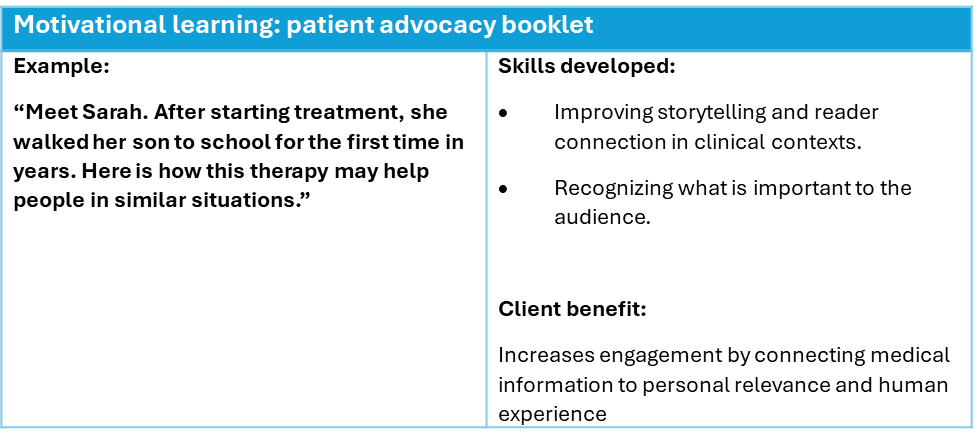
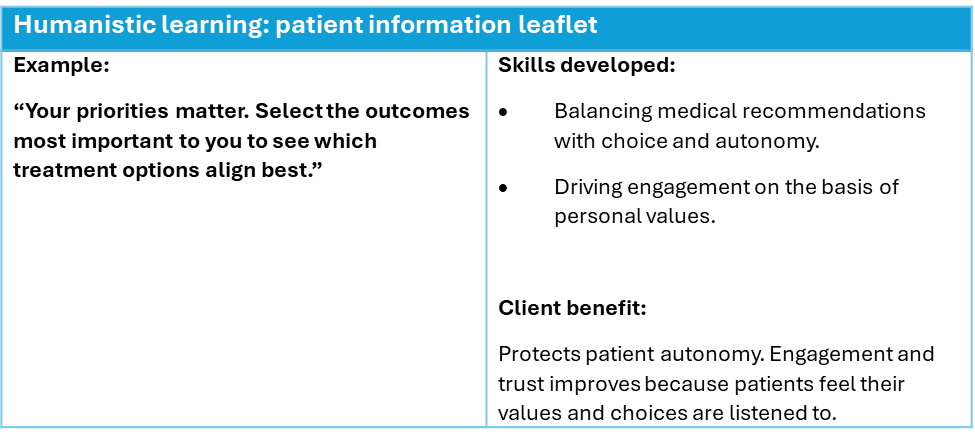
Motivational and humanistic models of learning rely on values, real-life relevance and emotional connection to drive learning. When learning feels meaningful and relevant, people work harder and retain more information. Recent research found that medical students taught using human-centered methods reported greater motivation and satisfaction in their learning, in addition to attaining higher skill scores.2 This evidence underpins the blending of informational accuracy with personal relevance; for example, framing outcomes through patient stories can make data both meaningful and memorable.
Personal Perspective
In practice, adult learning theories can be used to improve medical writing skills and increase effective engagement with the content produced. The following examples reflect my personal perspective on how integrating evidence-based approaches into writing practice benefits both the writer and the client in a variety of real-world contexts.
Key Takeaways
Adult learning theories highlight the fundamental values that influence the understanding and retention of new information. By integrating these principles and values into their work, medical writers can improve their own skills while also enhancing the quality and impact of their work by aiming to apply the following key principles:
Design content that empowers choice.
Challenge assumptions with evidence.
Build community through shared voices.
Write with empathy and relevance to human experience.
References
Palis AG, Quiros PA. Adult learning principles and presentation pearls. Middle East Afr J Ophthalmol. 2014;21(2):114-122.
Wei H, Sheng N, Wang X, Zhang Z. Enhancing Practical Skills in Medical Education: Evaluating the Efficacy of Virtual Simulation Teaching Through Kolb’s Experiential Learning Model. Adv Med Educ Pract. 2025;16:1129-1139.
Aulakh, J., Wahab, H., Richards, C. et al. Self-directed learning versus traditional didactic learning in undergraduate medical education: a systemic review and meta-analysis. BMC Med Educ. 2025; 25 (70)
Bylund CL, Vasquez TS, Peterson EB, et al. Effect of Experiential Communication Skills Education on Graduate Medical Education Trainees’ Communication Behaviors: A Systematic Review. Acad Med. 2022;97(12):1854-1866.
Liu Z, Yu R, Yao X, Yan Q. The impact of feedback elements in serious games on nursing learning outcomes: A systematic review and meta-analysis. Nurse Educ Today. 2025; 150.
AI Disclaimer
ChatGPT was used to edit this article for structural format modifications.
Contributions of Blog Creator
Nicole Bowens, PhD, developed the topic and selected one of the references for this article. She created this blog to bring together perspectives from medical writers at all experience levels, with the goal of supporting those who are aspiring or early in their careers.
If you are interested in contributing to the blog as a writer or editor, fill out the Google form application, and you will receive a follow-up email with further instructions.
Contributor Contact Info
Writer: Xanthea Heighington, PhD
🔗 LinkedIn: www.linkedin.com/in/xanthea-heighington-phd-413084156
Editor: Dr Reena Shetty
📧 Email: DrReenaShetty@gmail.com