
Information Overload: Finding the Right Balance to Enable Success in Medical Writing (info overload perspective 2)
Understanding the Cognitive Challenges Posed by Our Information-Rich World is Key to Unlocking Optimal Learning in Medical Writing
Written By: Jenna Petronglo, PhD
Edited By: Siddharth Mohan, MPH
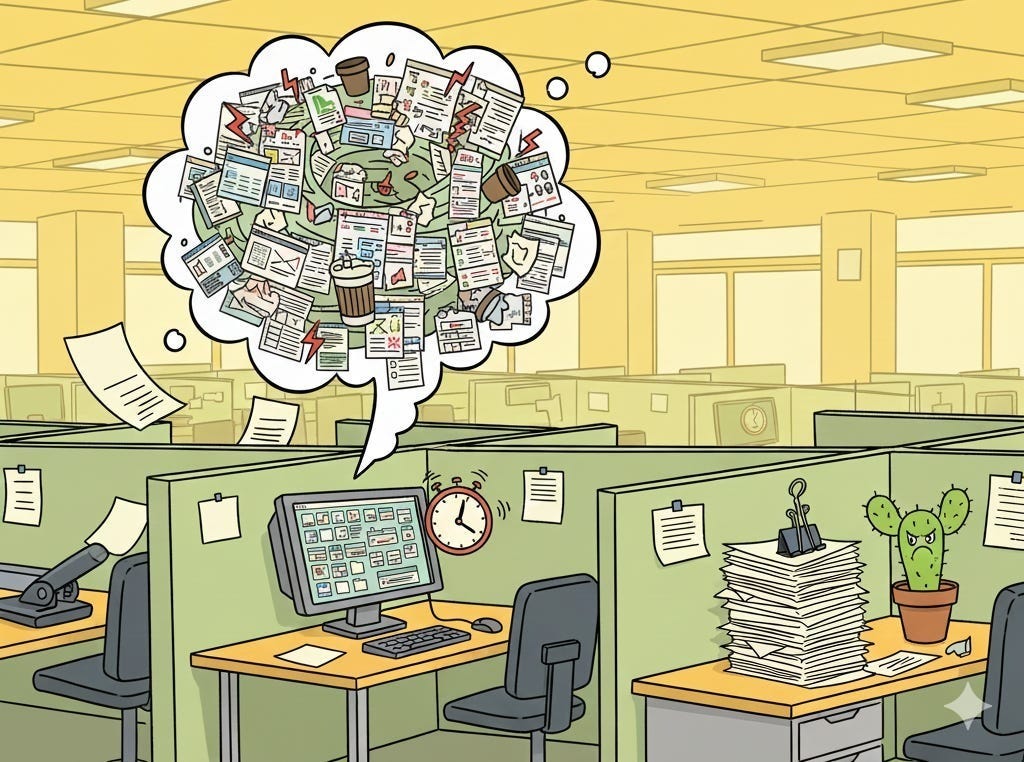
Medical writers and researchers today face a paradox: information to enhance subject matter expertise and empower career growth is more accessible than ever, but choosing from the vast number of available resources can be overwhelming, ultimately stymying progress. The struggle to decide what information to consume and how is often referred to as “information overload.” This article examines the experience of information overload, using psychology and neuroscience research as a framework to understand why we as medical writers feel overloaded and what we can do about it.
Research/Evidence
The exhaustion induced by too many choices was originally defined as “decision fatigue” by researchers studying consumer habits. Researchers found that an abundance of choice can actually demotivate shoppers, leading to a loss of sales. The decision fatigue concept has since been applied to other settings, such as stock trading and even dating. In the early 2000s, research began applying the decision fatigue framework to learning and working in technical and scientific sectors, coining the term “information overload.” Cognitive load theorists have since added to our technical understanding of the problem, defining that information overload occurs when the quantity of information available exceeds the working memory of the individual who is receiving that information. The costs of information overload include reduced productivity and cognitive and emotional stress.
In the United States alone, nearly half a million scientific and technical research articles were published in 2022. Any medical writer who has ever performed a PubMed search is probably quite familiar with their own limitations in working memory. With so many articles to potentially read, and so many medical-writer-focused workshops and trainings to choose from, how can we curate the right resources to avoid the inefficient learning, lost productivity, and emotional anguish caused by information overload?
Personal Perspective
As a scientist and aspiring medical writer, I deal with information overload and underlying decision fatigue every day. My web browser is typically packed with tabs containing articles I am planning to read at some point…well, eventually! It’s reassuring to know that others are contending with this issue, and that researchers in psychology and neuroscience recognize it as a problem deserving of definitions and solutions. Fortunately, some evidence-based strategies work well for contending with the onslaught of information we are faced with.
When trying to change your relationship with the information at your fingertips, curation is key. Researchers have noted that information overload is influenced by the capacity of the person consuming, as well as the quality of the information. This means we have control over a variable—the value of what we interact with. For me, this may mean going through my browser tabs and asking myself if the information I’ve flagged is high-quality. Is it written in a way that I can understand well? Are there parts of the article that are dense, and if so, does the information within that section really align with my reading goals? I can spend a minute or two screening articles to decide if I still need to read the entire piece. This will help to curate the resources down to what aligns with my goals and with what will be the most efficient use of reading time.
Moreover, technostress—the stress brought on by constant connectivity to the internet and to the demands of one’s job—is a significant aspect of what makes information overload so toxic. The brain needs rest time. To contend with this, we can be mindful about when and how often we seek information online. For instance, perhaps a medical writer setting a goal to grow expertise in a particular area could reserve an hour in the morning to read on that specific topic. But when the allotted time is up, they can close out of those tabs and not engage again until the next morning. This reserves space for rest, setting a barrier against the antagonism of constant open tabs and repeated information searches occurring throughout the day.
Key Takeaways
Information overload occurs when a person’s working memory is exceeded by the amount of information in front of them.
The onset of information overload is influenced by the individual’s cognitive capacity and by the quantity and quality of the information.
We have the power to curate what information we consume to prevent information overload.
We can set goals for our learning, designate allotted time windows for learning, and turn down learning opportunities that don’t fit with our goals.
Try the bite-sized lesson to get hands-on practice with finding references to quickly get up to speed on a new topic.
Other Voices on This Topic
Consider reading these additional articles for unique perspectives and advice.
Using task management systems and peer support to stay organized
References
Arnold M, Goldschmitt M, Rigotti T. Dealing with information overload: a comprehensive review. Front Psychol. 2023 Jun 21;14:1122200.
Eppler MJ, Mengis J. The concept of information overload: a review of literature from organization science, accounting, marketing, MIS, and related disciplines. Inf Soc. 2004;20(5):325-344.
Hall A, Walton G. Information overload within the health care system: a literature review. Health Inf Libr J. 2004 Jun;21(2):102-108.
Iyengar SS, Lepper MR. When choice is demotivating: can one desire too much of a good thing? J Pers Soc Psychol. 2000 Dec;79(6):995-1006.
Maggio LA, Artino AR Jr. Staying up to date and managing information overload. J Grad Med Educ. 2018 Oct;10(5):597-598.
Ritchie H, Mathieu E, Roser M. Research and development [Internet]. Oxford (UK): Our World in Data; 2023 [cited 2026 Jan 3].
AI Disclaimer
ChatGPT was used to standardize the citation formatting for this article.
Contributions of Blog Creator
Nicole Bowens, PhD, developed the topic and selected some of the references for this article. She created this blog to bring together perspectives from medical writers at all experience levels, with the goal of supporting those who are aspiring or early in their careers.
If you are interested in contributing to the blog as a writer or editor, fill out the Google form application, and you will receive a follow-up email with further instructions.
Contributor Contact Info
Writer: Jenna Petronglo, PhD
📧 Email: petronglo@gmail.com
🔗 LinkedIn: https://www.linkedin.com/in/jennapetronglo/
Editor: Siddharth Mohan, MPH
📧 Email: mohansiddharth026@gmail.com
🔗 LinkedIn: https://www.linkedin.com/in/mohan-siddharth/
✨✨✨great perspective here
I like the key takeaway of allotting time windows for learning, and turning down learning opportunities. Notes taken.